LMTD Method
Overview
The Log-Mean Temperature Difference (LMTD) method is the classical approach for heat exchanger sizing and rating. It provides an analytical expression for the effective mean temperature difference driving heat transfer (Incropera et al., 2007).
Derivation
For a 2-stream heat exchanger with constant overall heat transfer coefficient \(U\) and constant specific heats, the rate equation is:
where the log-mean temperature difference is:
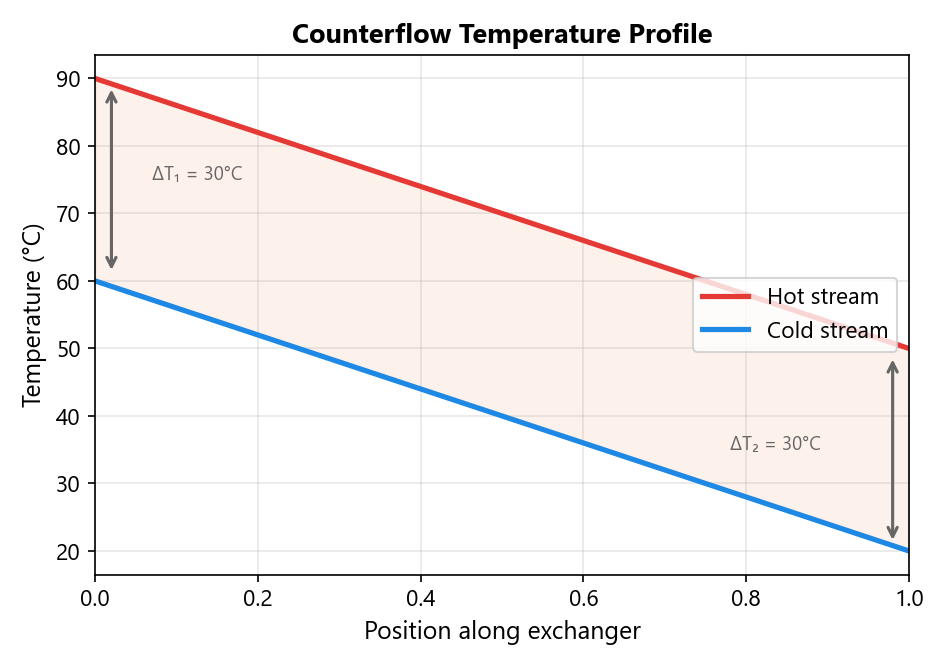
Counterflow
Co-current
Special Case: \(\Delta T_1 = \Delta T_2\)
When both temperature differences are equal (balanced counterflow with \(C_h = C_c\)), the LMTD formula yields 0/0. The correct limit is:
The implementation handles this case by returning the arithmetic mean when \(|\Delta T_1 - \Delta T_2| < 0.001\) K.
Zone-by-Zone LMTD
For multi-stream heat exchangers and cases involving phase change, the assumption of constant \(U\) and \(c_p\) is not valid over the full length of the exchanger. The MSHX implementation uses a zone-by-zone approach:
- Divide the exchanger into \(N\) zones of equal fractional heat duty
- In each zone \(j\), compute local \(\Delta T_1^{(j)}\) and \(\Delta T_2^{(j)}\) from composite curves
- Calculate the local LMTD for each zone
- Sum the zone UA contributions:
The effective LMTD for the entire exchanger is then:
Number of Zones
The implementation uses a minimum of 50 zones for the UA calculation (configurable via the NumberOfSegments parameter). More zones improve accuracy near pinch points where the temperature difference changes rapidly.
Limitations
The LMTD method has important limitations that motivate the use of more rigorous approaches:
| Limitation | Impact |
|---|---|
| Assumes constant \(U\) | Inaccurate when \(U\) varies with temperature |
| Assumes constant \(c_p\) | Fails near phase boundaries |
| Limited to 2 streams | Cannot handle multi-stream configurations directly |
| Requires outlet temperatures | Cannot solve directly for unknown outlets (iterative) |
These limitations are addressed by the e-NTU method (for direct outlet prediction) and the segmented interval method (for rigorous multi-stream analysis).